

How to Take Care of Your Eyes in the Digital Age
Today, we strain our eyes more than ever. Just a few decades ago, our lives followed the natural day and night cycle that our ancestors lived for millennia; the stimuli our eyes received were balanced and adapted to sunlight. However, today we live a very different reality.
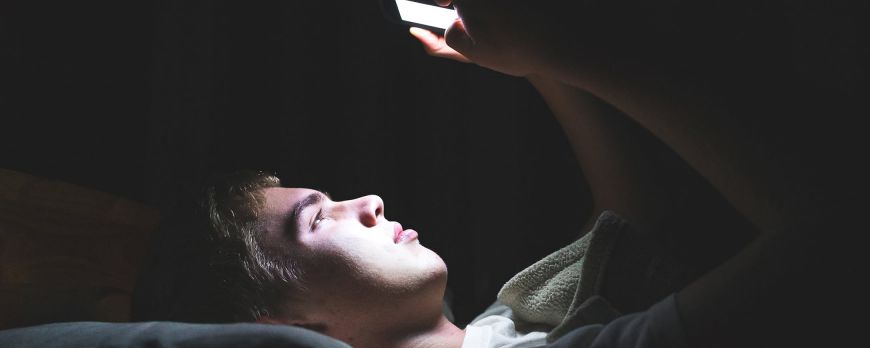
It is increasingly common to feel eye strain, dryness, blurred vision, or those annoying headaches at the end of the day. Whether it's from working on a computer, online classes, or entertainment—series, social media, video games—we spend most of the day glued to a screen. Intensive use causes our eyesight to process intense stimuli at hours when our brain should already be resting.
But don't worry. In this article, we will look at the challenges our eyes face, how to interpret their signals, and what to do to restore the well-being they need.
What our eyes are exposed to
Our eyes were not made to stare at a fixed point 40 centimeters away for eight hours (or more) a day. This overexposure poses several challenges:
• High-energy blue light: Blue light is part of the natural spectrum (the sun emits it), and it is necessary to regulate our sleep cycle. The problem is overload. LED devices emit a concentrated amount that can alter melatonin production, affecting sleep, and generate oxidative stress in retinal cells.
While midday sunlight has a balanced color temperature of about 6500 K, many modern screens are factory-set to 9300 K. This bluer tone makes images "look better" at the cost of bombarding our eyes with a dose of blue light much more aggressive than what we find in nature.
• Dryness from lack of blinking: The eyes are a very sensitive organ that needs to be well lubricated. It is a curious but alarming fact: we normally blink about 15-20 times per minute. In front of a screen, that frequency drops to 5-7 times. The result is an unstable tear film and red eyes.
• Digital Eye Strain (Asthenopia): When looking at a screen, the eye performs thousands of micro-focusing adjustments. This exhausts the eye muscles, causing that "tired eye" sensation or sharp pains.
How to distinguish the help signals your eyes send you
Often, our body warns us before a temporary discomfort becomes a chronic problem. Learning to read these signals is vital. Let's look at some signals our eyes send us and how to interpret them.
Chronic eye stress or occasional fatigue?
If after a weekend break your eyes feel "like new," it is probably occasional fatigue. However, if blurred vision persists upon waking or headaches in the temple area are daily, your visual system is suffering from chronic stress. This can lead to increased light sensitivity (photophobia) or difficulty focusing on distant objects after using a mobile phone.
Adults and children express themselves differently
In adults, the most common symptom is dry eye and fatigue. But in children, we must be more attentive: they rarely complain about "seeing poorly" because they have no point of comparison; they might think everyone sees that way. If you see your child rubbing their eyes a lot, getting too close to screens, or blinking excessively, it's time to act. Studies suggest that excessive near vision (using a phone or tablet) and lack of natural light are increasing cases of childhood myopia.
Important note: Listening to your body doesn't mean being alarmist, but it doesn't mean being overly relaxed either. Reactive prevention (acting only when it hurts) is usually more complicated and expensive than preventive care.
"In a world full of screens, taking care of your eyesight is more important than ever; your 'future self' will thank you."
Habits to take care of our sight (Prevention is better than cure)
Imagine your eyes are like a car engine: if you always run it at maximum RPM without oil, it will eventually fail. Here are some suggestions on how to "tune up" your daily habits to reduce wear and tear:
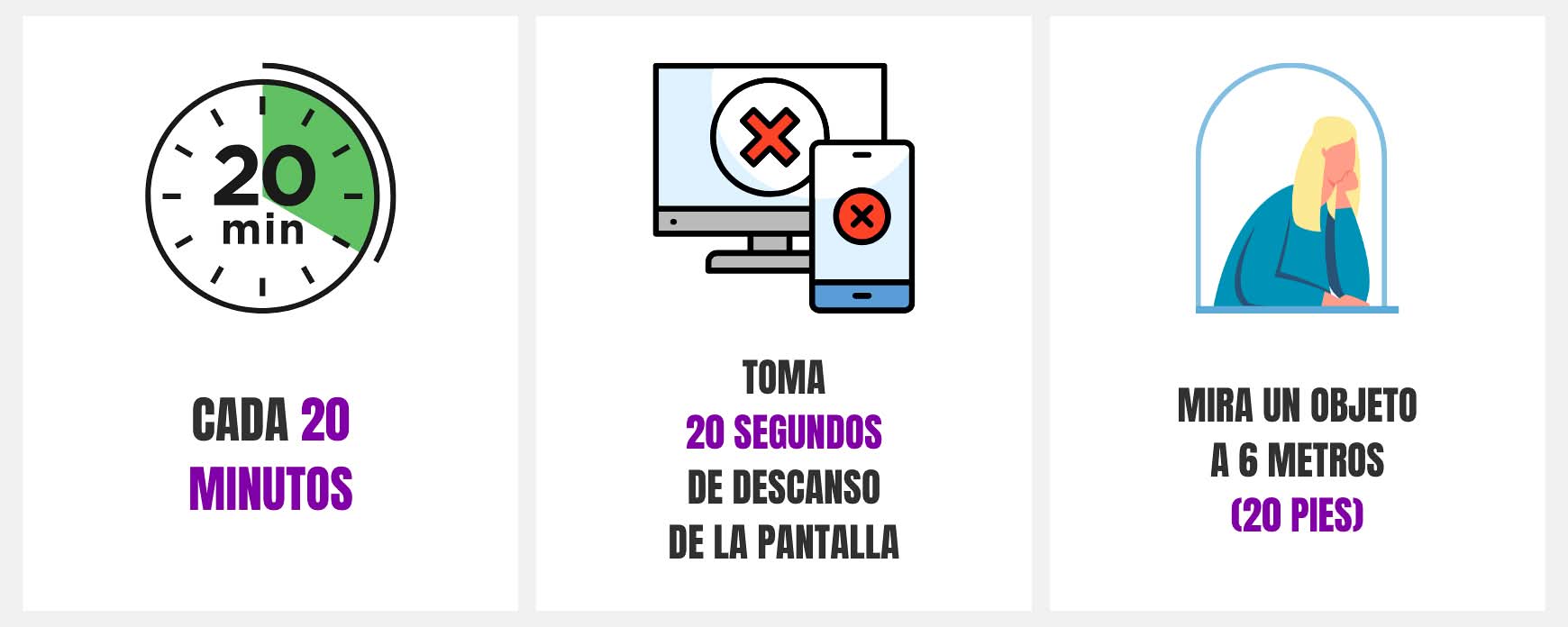
The 20-20-20 rule
It is the gold standard in visual health. Every 20 minutes, look away from the screen and look at an object about 6 meters (20 feet, hence the name) away for at least 20 seconds. This relaxes the ciliary muscle, responsible for near focusing.
Blue light filters and environment setup
You don't need to buy or wear uncomfortable blue light filtering glasses. Most operating systems already include native solutions:
• On Windows, Mac, Android, and iOS: Activate "Night Light" in the display settings. These systems also usually allow it to be activated and deactivated automatically at sunrise and sunset.
• Adjust your monitor: As we mentioned, many screens come configured with color settings that emit more blue light than the sun itself. Adjusting 1) the color range to "neutral," 2) the contrast to 50-60%~, and 3) the maximum brightness according to your environment's lighting will help not to overstimulate your vision.
Don't forget to blink
Make an effort to blink enough. Sometimes, forcing yourself to close your eyes completely every now and then helps regenerate natural tears. Also, an artificial tear solution can be useful.
A balanced nutrition for healthy vision
Just as our muscles need protein or our bones need calcium, visual health directly depends on certain macro and micronutrients.
• Vitamin A (Retinol): Essential for night vision and corneal health. When we lack Vitamin A, we can suffer from severe dry eye. We find Vitamin A in carrots or pumpkins.
• Omega 3: This fatty acid is part of the retina's structure. It helps improve tear quality. It is even more important for those suffering from dry eye. Sardines, anchovies, or walnuts are excellent sources of Omega 3.
• Lutein: These are pigments that accumulate in the macula (the center of the retina) and act as "sunglasses," filtering harmful blue light. We get lutein from foods like spinach or chard.
• Zinc and Vitamin C: They function as potent antioxidants that protect eye cells from premature aging caused by free radicals. Lentils and chickpeas provide zinc. On the other hand, Vitamin C is found in oranges or kiwis.
We know that with today's pace of life, it's not always easy to maintain a perfect diet. Sometimes, the quality of supermarket food or lack of time doesn't allow us to get all the vitamins and minerals our eyes need.
To cover those gaps, dietary supplements are an excellent tool. At Exialoe, we have developed specific formulas to help you:
• Antioxi (with cranberry, bilberry, and lutein): The combination of lutein (which acts as a blue light filter) and bilberry (which improves microcirculation) helps strengthen the visual system. It is fundamental aid to prevent premature wear and protect tissues against conditions such as macular degeneration or cataracts.
• Exi-DHA and Omega 3: Not all fish oils are the same. At Exialoe, we have the IFOS seal, which guarantees purity, the absence of heavy metals, and general quality.
• Aloe Juice with Royal Jelly and vitamins A, D, and E: Aloe vera helps by improving bioavailability, allowing your body to absorb vitamins A and E much better.
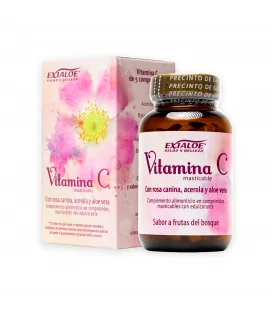
• Vitamin C: Its chewable tablets (formulated with the best sources like Rose Hip) provide the complete Vitamin C intake our body needs.
Common visual diseases: When to see a professional
Beyond habits, there are conditions that arise due to genetic factors or the passage of time. Knowing them helps us act in time:
• Presbyopia (Tired eyes): Usually appears from age 40-45 because the lens loses elasticity. It is a natural process, but requires proper prescription to avoid generating extra fatigue.
• Cataracts: Caused by the clouding of the lens. Although associated with age, excessive UV radiation without protection accelerates its appearance.
• Glaucoma: Known as "silent blindness." It is due to an increase in intraocular pressure that damages the optic nerve. It usually gives no symptoms until it is advanced, so annual check-ups are the only way to detect it.
It is always a good idea to have a professional check your eyesight once every two years if you are under 40 and once every year for those over 40.
Sight is one of the senses we value most; it gives us the colors of a sunrise, the detail of a flower, and the faces of the people we love. In a world full of screens, taking care of your vision is more important than ever; your "future self" will thank you.
Productos relacionados

 42,00 €
 25,00 €
 41,00 €
 79,00 €
Featured articles

Protect yourself from colds as autumn returns
Ready to face September without colds? Discover practical, easy tips — hygiene, ventilation, nutrition, and rest —...Read More
5 Hábitos para Cuidar tu Cerebro

Vacaciones Exialoe 2026 - Islantilla